

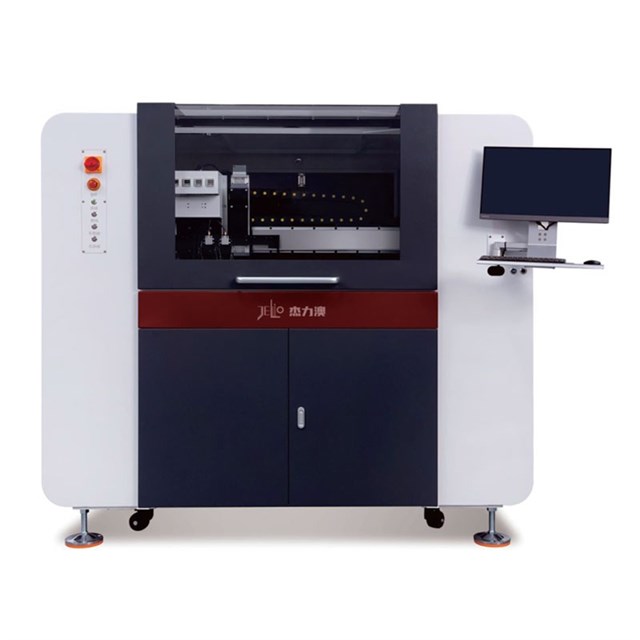
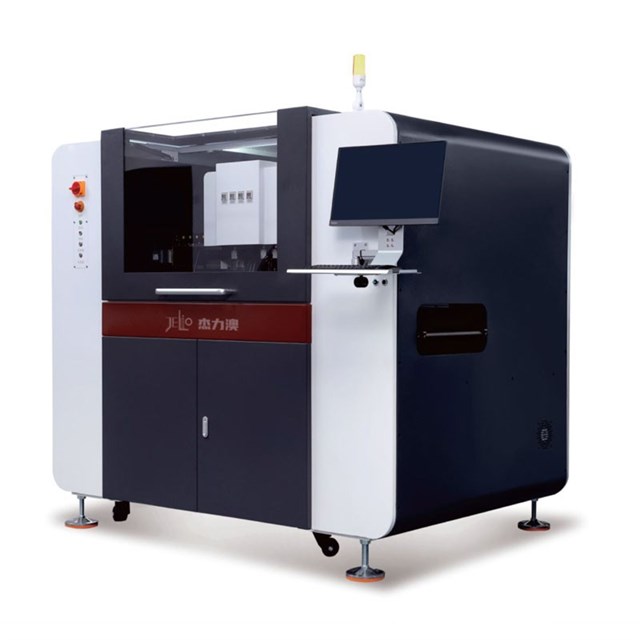
TECHNICAL SPECIFICATIONS
| Model | JLO-CXJ3235 |
| Number of Workstations | Dual Station |
| Max. PCB Depaneling Size | 320mm(X)*350mm(Y) (Single Station) |
| Machine Travel | 950mm(X)*700mm(Y)*100mm(Z) |
| PCBA Component Height | Milling/Saw: Upper:15mm/10mm Lower:45mm |
| Repeatability | ±0.02mm |
| Cutting Accuracy | ±0.05mm |
| Repeat Cutting Accuracy | ±0.02mm |
| Cuttable PCBA Thickness | 0.5~4mm |
| Milling Spindle Tool Range | φ0.5~3mm |
| Saw Blade Tool Range | Saw blade thickness:0.3mm; Diameter:100mm |
| Milling Spindle Speed | MAX:60000rpm |
| Saw Blade Motor Speed | MAX:8000rpm |
| Milling Spindle Power | MAX. 800 W |
| Saw Blade Motor Power | 400W |
| Mark Compensation | Camera recognition & positioning, automatic compensation |
| Cutting Speed | 0~100mm/sec |
| Moving Speed | XY:1000mm/s, Z:500mm/s |
| Milling Cutting Function | Straight line, L-shape, U-shape, circle, arc, etc |
| Saw Cutting Function | Straight line |
| Camera Pixel | 1.3 MP |
| Milling Cutter Replacement Method | Automatic tool change |
| Saw Blade Replacement Method | Manual tool change |
| Main Unit Power Specification | AC220V 50HZ 5.2KW |
| Dust Collector Power Specification | AC380V 50HZ 2.2KW |
| Dust Collection Method | Top follow-up dust collection |
| MES Connection | MES CSV text format (standard), barcode scanner (optional) |
| Machine Dimensions | 2200mm(L)*1400mm(W)*1800mm(H) |
| Machine Weight | 1300KG |
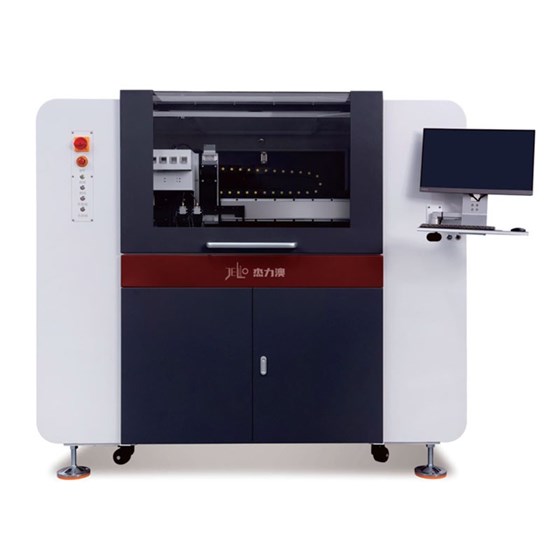
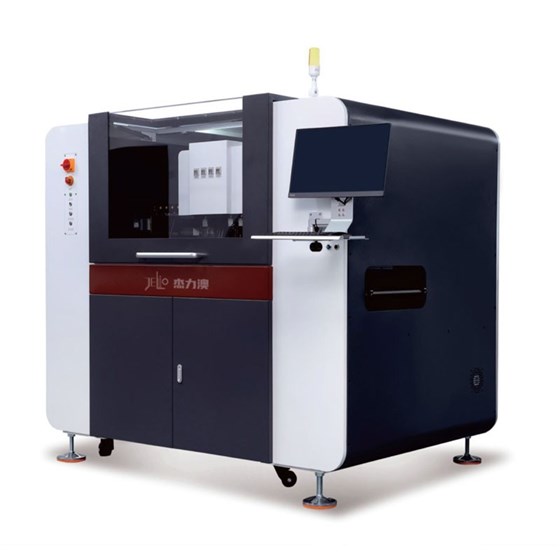
KEY FEATURES
1.1 Optimized structure allows fixtures to be fixed with no or few screws, reducing changeover time.
1.2 QR code reading for automatic program calling.
1.3 Supports camera-based programming.
The left and right workstations can copy programs to each other, which accurately simplifies programming time and greatly improves programming efficiency.
The CCD scans Mark points for positioning, identifies offset trajectories, and automatically corrects the cutting path to improve cutting accuracy and avoid cutting defects caused by board handling errors.
4.1 Supports up to 4 Mark scans, reducing the risk of abnormal downtime caused by failed Mark recognition during traditional dual-Mark detection.
4.2 Any identifiable position on the product can be set as a Mark for compensation.
4.3 When cutting multiple panels on the same fixture, Mark scanning can be performed separately for each panel.
By reading the barcode information of the carrier, the system verifies whether the program matches the carrier to prevent cutting errors.
6.1 The program automatically corrects the cutting path when the product is tilted at a large angle, reducing debugging time.
6.2 If the product is not properly placed, the machine will stop and alarm.